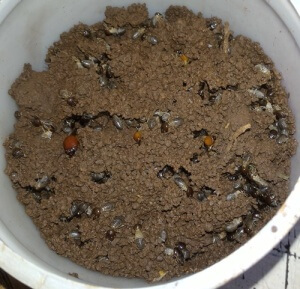
Living termite dish.
This is a follow-up story on a series of special reports published in 2015 from Vihiga County, Kenya, where Humidtropics researchers are empowering the community to better use available agricultural biodiversity to improve nutrition all the year round. In this report, the author describes a series of events organized by the communities to start the interventions that aim to improve their nutrition. These events included everyone bringing along their diverse local food dishes, including a dish of living termites which are a great source of animal protein.Â
Rural populations in developing countries often face food insecurity and malnutrition despite being often surrounded by extraordinary biodiversity. Vihiga County is rich in local food biodiversity. However, the diets of women and small children in the region are not diverse enough. Chronic malnutrition (stunting) affects 28% of the children. We are also seeing different forms of malnutrition in the caregivers – 8% are underweight while 18% are overweight with 7% classed as obese. This project will help to make better use of Vihiga’s agricultural potential in order to improve people’s diets.
Our previous blog reported on the participatory development of agricultural interventions. For two months, six community workshops were carried out in five sub-locations of Vihiga County. In each sub-location about 34 people took part (170 workshop participants in total). The workshops encouraged the participants to develop their own strategies to diversify diets in their community by using local food biodiversity. Most of the groups have chosen planting of vegetables and/or planting of legumes and poultry-keeping. Community action plans were developed that specified how exactly the interventions are to be realized.
Moving towards the implementation phase, Bioversity International wants to ensure that action goes beyond the 170 initial workshop participants and reaches the whole community. Therefore, we organized community events to officially kick-off the intervention phase and help spread the word.
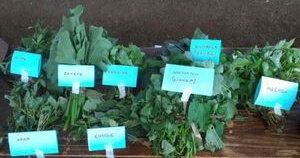
A selection of local leafy vegetables.
The Masana workshop group has been one of the most creative in teaching the wider community about what they have learned during the workshops. Besides presenting a song and poems, the workshop participants gathered all types of local foods and distributed them on tables according to the different food groups they were taught about in the workshops. These included up to eight kinds of green leafy vegetables, most of them indigenous types like cowpea leaves (“kundeâ€), black nightshade (“managuâ€), spiderplant (“sagaâ€), jute (“mrendaâ€) and pumpkin leaves (“severeâ€).
These well-known vegetables that have been considered as ‘food for the poor’ earlier, have gained popularity in Western Kenya within the last years. Reasons for this include campaigns by the Ministry of Health and NGOs to promote the nutritional value of indigenous leafy vegetables which are rich in many micro-nutrients and can be crucial for the food and nutrition security of poor families.

Food fair participants.
The workshop participants did not hesitate to bring living objects in order to demonstrate the animal protein food group: a chicken, birds in cages and a box of crawling termites. One participant told me that termites are eaten either raw or fried. Another spoke about the importance of complementary feeding, the transition from exclusive breastfeeding to family foods, covering the period from 6 to 18-24 months of age: “Our babies should not only rely on porridge which is mostly water and carbohydrates. After they have turned 6 months, we can also feed them a variety of foods.â€
Apart from showing the food diversity of their community and how they enable a diverse diet, workshop participants also explained their planned nutrition interventions. In order to diversify their diets, the Masana group chose to grow different kinds of indigenous vegetables, as well as a few legumes. In addition, they want to raise poultry. The planting of vegetables and legumes will happen on the members’ individual farms, whereas poultry keeping will be done in a communal place. They have also developed a budget and ways to raise funds within the group to finance the activities. As stated in their community action plan, one of the first steps to start these activities is the recruitment and registration of members. The guests of the event were offered the opportunity to join the project.

Example of a balanced food dish.
The kick-off event finished with a lunch that represented the principles of a balanced meal. It included a staple food (rice), a protein rich food (beans), vegetables (cabbage) and a piece of fruit (orange, avocado).
We will closely follow the intervention communities for one year and monitor their progress towards reaching adequate diets for small children and the community as a whole. A final community survey is planned for October 2016 to assess the impact of the whole participatory methodology. The results of five intervention communities will be compared with those of five non-intervention communities.
This research is being carried out in collaboration with the CGIAR Research Program on Agriculture for Nutrition and Health (A4NH) as part of Bioversity International’s Healthy Diets from Sustainable Food Systems initiative.
Read the other “Nutrition in Kenya” blogs about this research:
Nutrition in Kenya: Putting Nutritious Diversity Back on the Plate
Nutrition in Kenya: Community Action Gathers Momentum
Nutrition in Kenya: Malezi Bora Week – Food Biodiversity for Improved Nutrition
Blog by Julia Boedecker, Associate Scientist, Bioversity International; blog edited by Valérie Poiré, Communication Officer, Humidtropics. Photos by Bioversity International/J. Boedecker.
Read the original blog on Bioversity International’s website.