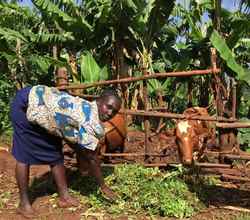
Mary Adoyo* is a Kenyan smallholder farmer in Masana sub-location, Vihiga county in Western Kenya. For much of the year, she manages the family farm alone while her husband works in Nairobi to support his family with monthly remittances. She produces enough maize on their one acre plot to supply her family with maize meals for only six months of the year. Their farm also produces beans, bananas, sweet potatoes, avocados, mangoes, papayas, lettuce, kales and traditional Kenyan vegetables such as mitoo (Crotalaria spp.). Many of these products are sold locally to generate money to purchase food … [Read more...]
An Environmentally-Friendly Innovation Turns Maize Residue into Fertilizer in Thailand

Humidtropics researchers and partners from Chiang Mai University (CMU) and Chulalongkorn University (CU) in Northern Thailand are testing a more environmentally-friendly method to process maize residue. Driven by the Humidtropics Research for Development (R4D) Platform in Nan, Thailand, this initiative is part of a project aiming to improve natural resource management. Towards the end of the dry season, Northern Thailand was covered with thick smoke originating from fires all over the area and the neighbouring countries. The smoke is partially from forest fires, but also originates from … [Read more...]
Impacting Smallholder Agriculture in Ethiopia

“Today I'm very happy to see the research outcomes on soil and water management practices reflected on the field, and to hear from the farmers how they appreciated the contribution of researchers. This is very significant for us and easy to scale out in the future. In this regard, Humidtropics and its Partners CIP, ILRI and IWMI did a very good job and served their purpose of striving to change lives, in particular in the areas where there are critical problems in natural resource management and shortage of fodder to feed livestock in the dry season†Dr. Hirpa Legesse, Wolega University, … [Read more...]