The ultimate goal of research on agricultural innovation is that it will be useful to farmers to enable them to enhance their productivity, income and living standards. Experience from Northwest Vietnam demonstrates that improving farmers’ participation in research will enable research uptake. Researchers found that farmers’ participation in research will increase their ownership of results and motivation to change their agricultural system for long-term benefits. Scientists can also benefit from farmers’ local knowledge.
This was what we learned from the project Agroforestry for Livelihoods of Smallholder Farmers in Northwest Vietnam (AFLI), supported by the Australian Centre for International Agricultural Research (ACIAR) and part of two CGIAR Research Programs: Humidtropics and Forests, Trees and Agroforestry (FTA). The project aims to develop best-practice agroforestry systems in order to provide farmers with diverse sources of income while sustaining the environment in Yen Bai, Dien Bien and Son La provinces. Research on sustainable diversification of agriculture is conducted in areas dominated by maize mono-cropping on sloping land susceptible to erosion and land degradation. This has been through research on agroforestry practices with grass-strips (fodder) and commercially valuable trees (fruit, timber), in combination with maize.
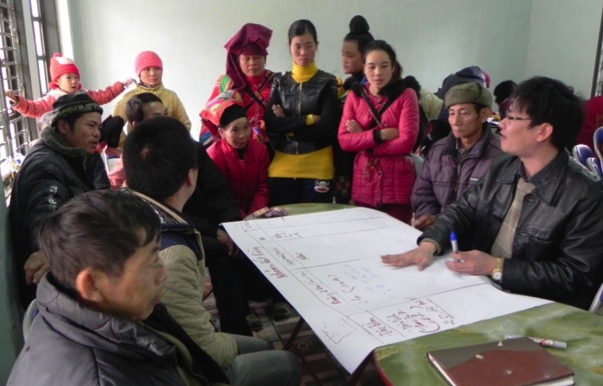
Thai farmers in Son La province participating in a crop-selection workshop. Photo by ICRAF/Mai Thanh Tu.
In this project, farmers were involved at different research stages. In the beginning, farmers designed the trials of the different agroforestry systems. Researchers used a wide range of participatory methods to jointly develop a list of five prioritized crops that were to be included in the trials. The criteria for selecting the crops included ease of cultivation, market demand, high value at sale and opportunities for adding more value.

Young ‘son tra’ fruit. Photo by ICRAF/Yessi Dewi Agustina.
‘When farmers are involved in the crop selection process, they are happy to take care of their trial plot’, said Dr La Nguyen, AFLI project manager. By involving farmers, scientists also learned from farmers’ local knowledge. ‘Son tra’ (Docynia indica) is a good example of how scientists benefit from it. Son tra is a tree species that grows naturally in Northwest Vietnam. It is known by the local name ‘H’mong apple’. Son tra is being domesticated as an AFLI initiative, and a value chain analysis of was conducted. Dr. Nguyen Thi Bich Thu of the National Institute of Medical Materials said that the traditional way of using son tra fruit was soaking it in alcohol, which retained its health benefits of strengthening the immune system and reducing obesity.
Scientists also trained farmers on how to establish community nurseries so that they could be self-sufficient in tree seedlings. The AFLI project mostly assists farmers to improve their knowledge and capacity. None of the farmers are paid for participating even though they contribute their land and labour for the nurseries and trial plots. In so doing, researchers find farmers with motivation to adopt the agroforestry models. They were impressed that two farmers in Dien Bien and Son La provinces had volunteered their own land to build the nurseries, which demonstrated their motivation and long-term commitment. Each nursery was managed by 15 households and aimed to produce about 5,000 seedlings for the group members.
Farmers were also involved in measuring the performance of the agroforestry systems. They could see with their own eyes how a fodder-grass barrier could help to reduce soil erosion and the benefits of growing perennial crops, such as fruit trees.
‘We may have lower income for the first two years but in the long run we will have much better income compared to maize, cassava and rice, especially when upland fertility is becoming poorer and poorer’, said Giang Giong Vu, a H’mong farmer who is participating in a son tra and fodder-grasses trial established with the support of the AFLI project. After four years of implementation, AFLI has established 11 agroforestry trials and six farmer demonstration trials, covering nearly 50 hectares, with around 100 households involved.
However, a challenge remains whether farmers have been informed enough so they can participate optimally. Researchers found that there should be more studies on marketing, especially on markets for new products being developed in the trials, such as macadamia or walnut. Another difficulty is to ensure the participation of marginalized groups, such as ethnic minorities and women. AFLI has endeavoured to include ethnic minority farmers, including publishing extension material in the H’mong language, but researchers need to pay more attention to gender equity, emphasized Nguyen Thi Thanh An, ACIAR Country Manager in Vietnam. This was something that could be addressed together with the farmers, reinforcing the participatory approach for maximizing benefits.
Blog by Thanh Tu Mai, Monitoring & Evaluation Officer, Humidtropics/ICRAF, edited by Robert Finlayson, Regional Communications Specialist, ICRAF, and Lisa Hiwasaki, Central Mekong Flagship Manager, Humidtropics/ICRAF. Blog edited by Valérie Poiré, Communication Officer, Humidtropics.