
Following the launch of Humidtropics in Uganda in August 2013, two Innovation Platforms were established, one in Kiboga-Kyankwanzi and another in Mukono-Wakiso. Both Platforms bring together different actors: national facilitators from Makerere University and the National Agricultural Research Organization (NARO), international research institutions, universities, local governments, international and local NGOs, farmer organizations and the private sector. These actors meet regularly to discuss the best way to implement the researchable entry points selected in their respective … [Read more...]
Testing Fuzzy Cognitive Mapping in two Humidtropics Innovation Platforms in Uganda
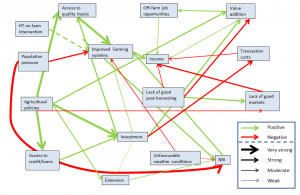
In the beginning of June, we - Wageningen University (WUR) and the International Institute of Tropical Agriculture (IITA) - tested ‘Fuzzy Cognitive Mapping’ (FCM) in two Humidtropics Innovation Platforms in Uganda. FCM is a semi-quantitative model approach, which allows stakeholders to visualise the strength of interactions between components of a system. In a next step, the FCM-software FuzzyDANCES calculates the impact of changes on the system. A nice aspect of FCM is that it can include both problems and opportunities, while taking into account feedback mechanisms. In general, … [Read more...]
Can Home Gardens be a Catalyst for Market-Based Integrated Systems?

At the start of the rainy season, some upland areas in Thailand and Vietnam offer a depressing sight of bare red-colored hill slopes, deep erosion gullies and the occasional charred tree trunk. Maize monocropping on sloping lands is the main direct culprit. The practice is destructive, yet profitable for farmers, at least in the short-run. The practice is stimulated by a high demand for maize from the rapidly growing livestock sector in other parts of the country, which is in turn related to rising urban incomes and associated changes in food habits. Hill slopes are difficult to cultivate, let … [Read more...]